Yesterday was the anniversary of my father’s death. For any of us, quiet reflection, maybe prayer would be appropriate on such a day. The closer one lives to the city’s premier green space, Forest Park, the harder it is to find quiet.
In the morning, inside my house with double-glazed windows and doors all closed tight, – the whine of leaf-blowers penetrates all efforts to shut out the noise.
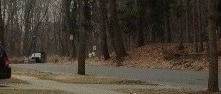
City dump truck and crew (in vests) disturbing the neighborhood peace.
After about an hour of that, I thought, if I walked in the opposite direction, into and through the park, I could escape. On entering, the blowing noise was audible all the way up the straightaway by the ballfields.
As I hit the road curve around the zoo, different machinery was operating and leaves and dust billowed across the road:
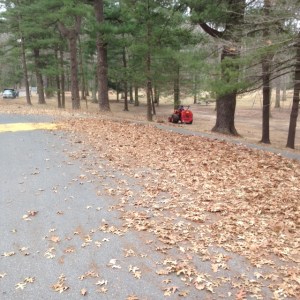
Dump truck on left, and tractor blowing leaves & dirt into the air in Forest Park, 25 February
To be fair, when I was directly opposite, the operator shut the tractor off until I was a little further along. As I passed the dump truck, I saw two employees with ear protection against the noise. Too bad, the ordinary people in the park don’t get ear protection or masks or respirators; neither do the animals, wild or captive.
Surely, once I made it beyond this spot, I’d find a bit of quiet! Passing along the road past the duck pond, more noise, – different noise. I could see another big green dump truck parked up to my right, lights blinking, but that was not the source.
Rather, up the road was the bright orange crane at work, – on the continuing mission to take down, metal frames, bulbs, trip wires and electrical tangles of “Bright Nights.”
The-powers-that-be in our city will brand me selfish to seek the solace of nature in Forest Park. A negative opinion of the great vehicle traffic and cash generator that is “Bright Nights” is a heresy.
That people in Springfield long to breathe clean air, to hear bird song, and see wild flowers or native shrubs (and an occasional animal) is too much to ask.
 Killing Forest Park